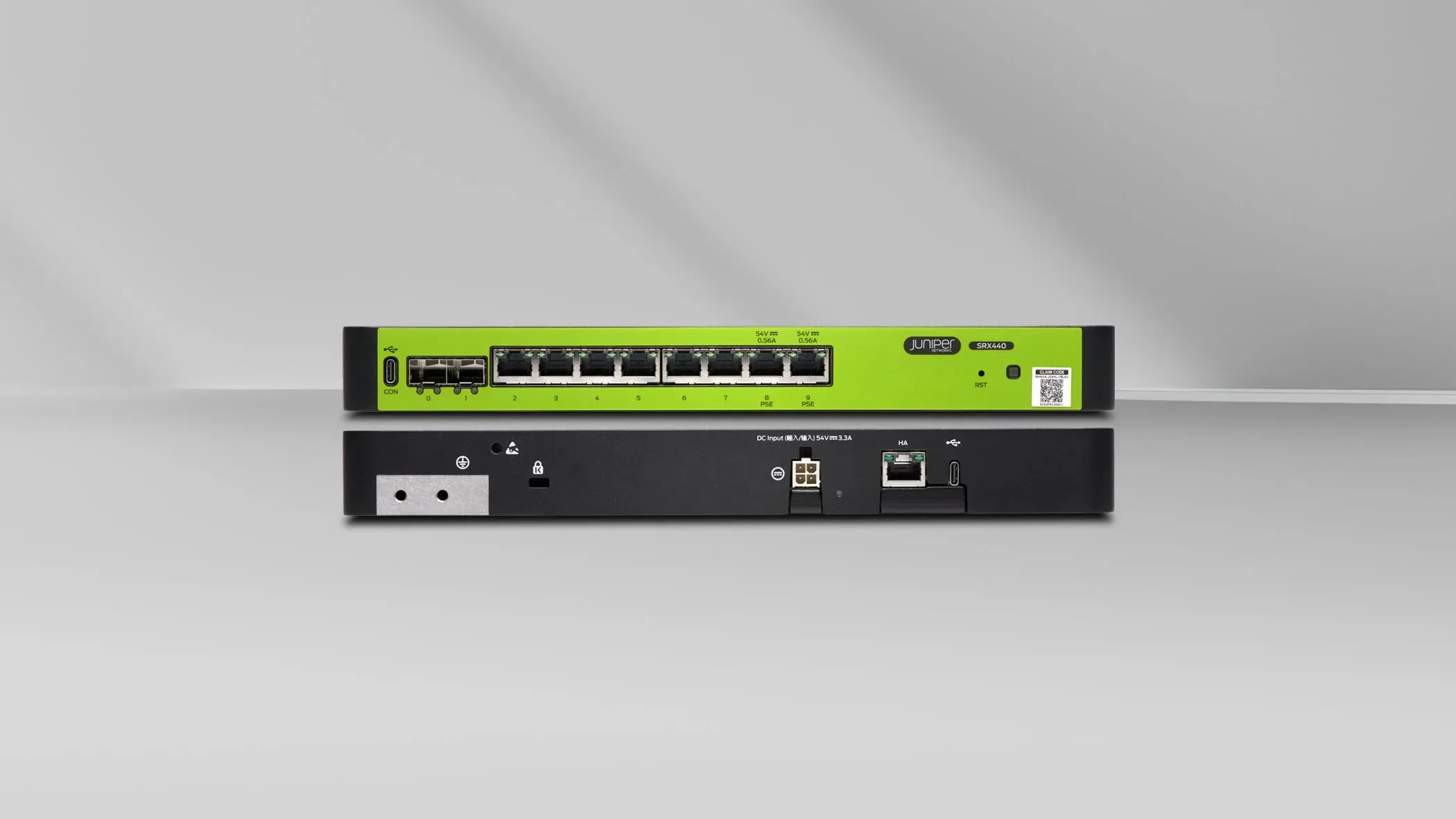
t RSA Conference 2026 in San Francisco, HPE unveiled a series of security innovations designed to help organizations safely embrace AI and make resilience a core part of their business operations. One of the most tangible announcements is the HPE Juniper Networking SRX400 Series: a compact next-generation firewall that brings carrier-grade security to the edge of the network.
Why the network edge deserves extra attention
As AI workloads spread across stores, clinics, campuses, and branch offices, these distributed locations are increasingly becoming the weakest link in the security chain. Unmanaged AI usage, inconsistent policy enforcement, and new data exposure risks are no longer theoretical concerns — they play out daily at sites that have traditionally received less security attention than the data center network.
The SRX400 series is designed precisely to address this problem. With a compact form factor, high performance, and hardware-rooted security, the appliance delivers the same security efficacy as larger systems while being suited for space-constrained environments. Hardware-rooted protections help defend against tampering and establish trusted device integrity — a critical requirement in environments where physical oversight is limited.
Management is handled through HPE Security Director, enabling organizations to standardize and enforce policy consistently from the network core to the most remote branch location.
AI in the workplace demands new layers of security
More than half of organizations are now using AI within their business processes. This creates a genuine dilemma: how do you give employees the freedom to work productively with AI tools while preventing sensitive business data from being inadvertently shared or leaked?
HPE addresses this with enhancements to its hybrid mesh firewall architecture. New capabilities include prompt-level inspection, allowing security teams to filter keywords and manage file uploads to external AI tools — without blocking access to approved applications. Administrators also gain immediate visibility into which AI applications are being used across the organization, with the ability to block access to unauthorized or high-risk AI websites with a single click.
Central to this approach is identity-based protection applied consistently across physical, virtual, and containerized environments. Security follows the user and the workload, not just the device.
Resilience as a strategic requirement
Beyond the SRX400 and the hybrid mesh enhancements, HPE is announcing a range of improvements to help organizations maintain operations under escalating threat conditions.
HPE Zerto Software is receiving enhanced support for recovery of virtualized workloads, including AI-related environments with vGPU support, along with Microsoft Defender integration. Direct access to immutable HPE StoreOnce data accelerates forensic investigation and recovery to a trusted, clean state following an incident.
On the confidential computing front, HPE is integrating confidential computing into HPE Morpheus Software, leveraging hardware-based trusted execution environments from AMD and Intel. Combined with centralized key management via Thales CipherTrust, data remains encrypted even while being processed — a significant step for organizations operating under strict sovereignty or compliance requirements.
Looking further ahead, HPE is also addressing the future of encryption. Post-quantum cryptography (PQC) is being added to Junos OS Evolved, with broader rollout to Junos planned for summer 2026. The implementation follows NIST standards and includes FIPS 203/204 support and a Quantum Buffer for SSH.
Threat intelligence as a continuous process
To give organizations faster insight into emerging threats, HPE is also expanding HPE Threat Labs. By incorporating additional networking telemetry and expertise, threat intelligence is converted into concrete action — in line with the broader vision of self-driving, zero trust security architectures.
Availability
The HPE Juniper Networking SRX400 Series and the new AI governance features for the hybrid mesh firewall will be available in Q2 2026. The remaining announced solutions will be rolled out in phases throughout 2026.
Want to know what these developments mean for your network infrastructure? Get in touch with our specialists for a no-obligation consultation.